In optics, imaging systems are used to create an image of an object of interest.
Note: OIS only care about the rays (whether they converge or diverge). So things could come from a “fake” object if it produces rays. Take care not to confuse everyday language with specific precise geometric optical language. A perfect OIS doesn’t depend on the angle .
An object is formed by light rays entering the optical system.
- It is real if the rays originate from a single point and diverge from it.
- Intuitively, objects are real if the rays originate from an actual physical source.
- A virtual image can also act as a real image when passed into another interface.
- It is virtual (i.e., the object isn’t really there) if the rays appear to converge into a single point beyond the entrance of the optical system.
- This is primarily used as a construct in lenses. For example, using a convex lens to first create a real image can be passed into a second lens as a virtual object.
An image is formed by light rays exiting the optical system.
- It is real if the rays converge to a single point.
- For example, the viewfinder in an SLR camera or an overhead projector are real images.
- It is virtual if they diverge from a point before the exit boundary of the optical system.
- Intuitively, if we see a virtual image of an object, the object isn’t actually at the image location. For example, looking through a mirror is a virtual image, because the light appears to be originating from behind the mirror.
- Generally, zooming mechanics (magnifying glasses) tend to produce virtual images as well, because they produce diverging rays that appear to come from a magnified object from a comfortable viewing distance (because our eyes can’t handle close objects!).
Objects are approximated as a collection of point sources. Points that are off the OA will send a cone of rays and similarly refract as those on the optical axis. Then, for a real image, it’ll converge in a similar way. This results in magnification.
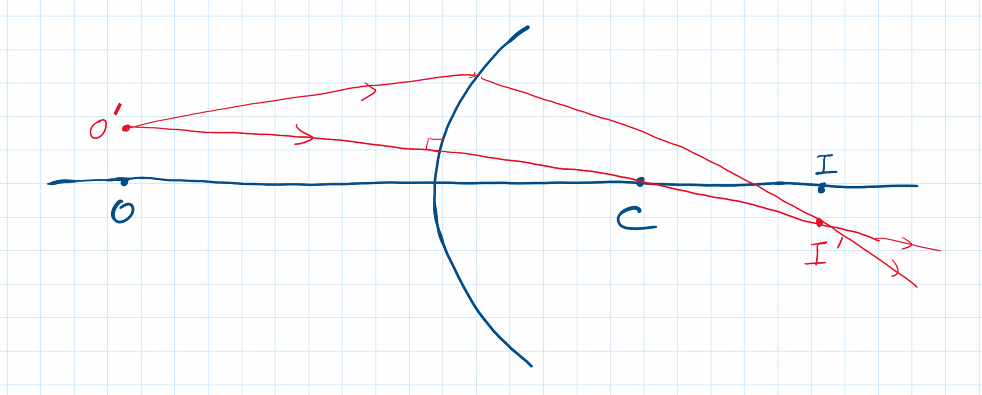 Note! Rays going through the optical centre (I assume where the OA intersects) won’t change direction, i.e., the angles wrt the optical axis are equal. Every OIS has an optical centre.
Calculations
In many basic imaging problems, we can get away with using the Gaussian formula, assuming the paraxial approximation holds. If it doesn’t hold, we may need to resort to using the three fundamental laws or Fermat’s principle.
The most important part is the sign convention. What the TA does is do the absolute value of everything, then add in the signs at the very end. We follow this convention:
- Real is positive — so for a real object/image, the length is positive. If virtual, then the length is negative.
- Left to right is positive — this is mainly useful for many concatenated lenses. Where is the radius intersection with the optical axis, and is where the interface crosses the OA:
- is positive when is to the left of (corresponds to a convex mirror).
- is negative when is to the right of (corresponds to a concave mirror).