The angular resolution of an optical sensor is the smallest angular separation of two points that can be resolved by the sensor. If the angle subtended by an object is less than the angular resolution, then the sensor can’t resolve the information (multiple points map to a single “pixel”). For the human eye, the angular resolution is about .
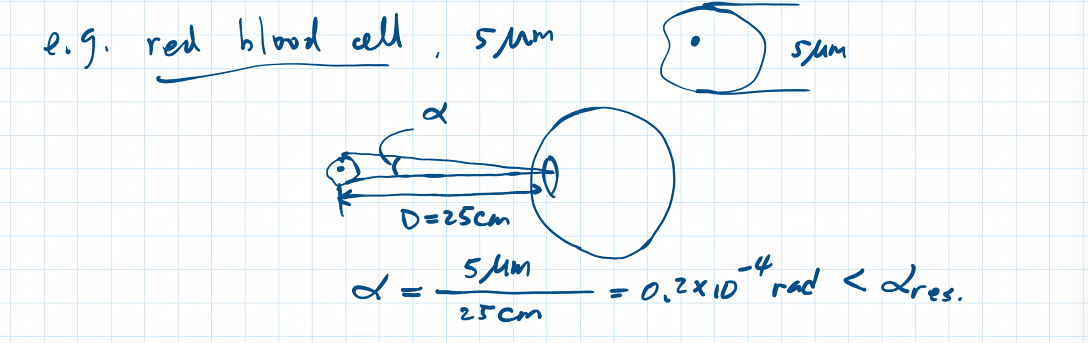
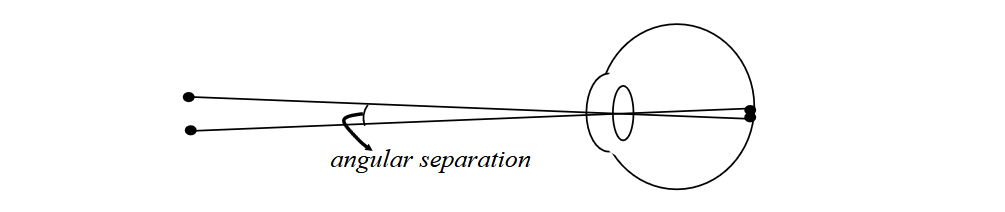 The resulting angle from an object of size at distance for an unaided eye is:
When we look through a magnifying glass (a convex lens), the resulting virtual image formed by the magnifying glass can have a much larger resulting angle at the eye than the unaided angle. As a result, it produces a much larger real image at the retina.
We define the magnifying power (MP) as the ratio of the magnified angle to the unaided angle. Note that the MP is different from the transverse magnification.
Construction
Suppose we have the eye:
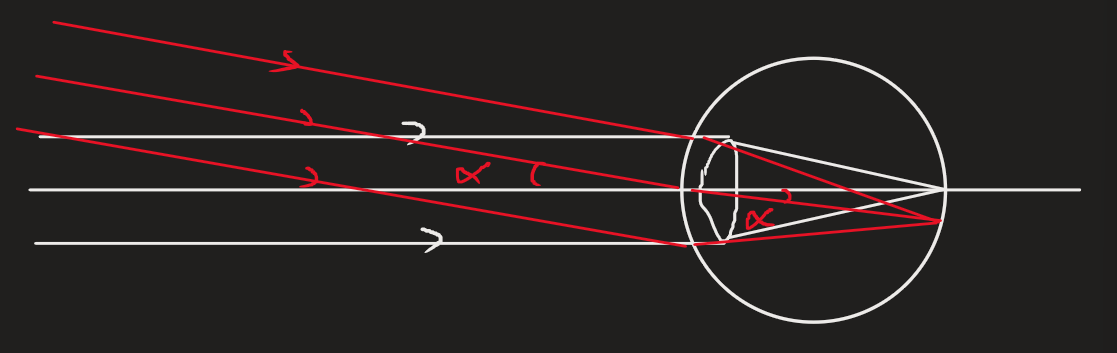 Note that the ray passing through the optical centre has the same angle . If the two points fall on two different photoreceptive cells, then they can be resolved by the sensor (our retina). Otherwise, we can’t resolve it.
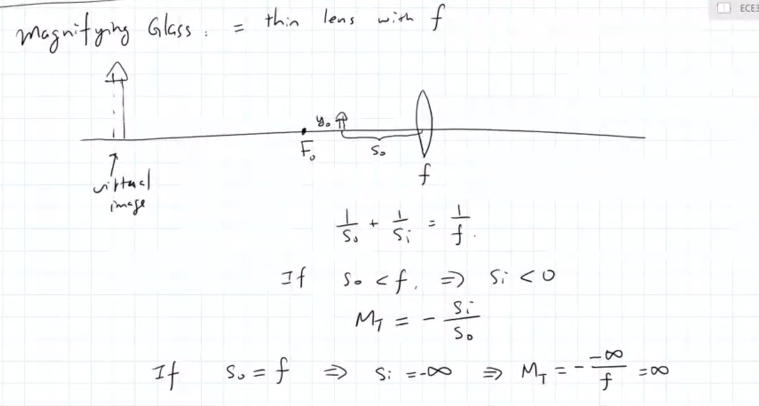
 magnifying glass:
- MT = -s_i/s_o
- when s_o = f, then s_i ⇒ infty
- M_T → infty
however, we still can’t see a red blood cell. it’s not the size of the object (or size of the image), but the angle subtended by the object that matters!
=(-s_i/s_o)/(-s_i/y_o) = y_o/s_o
s_o == distance from magnifying glass
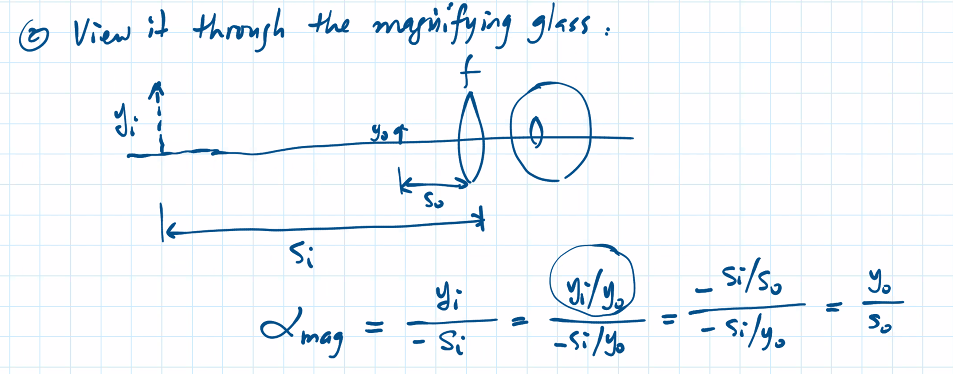 define: magnifying power transverse magnification

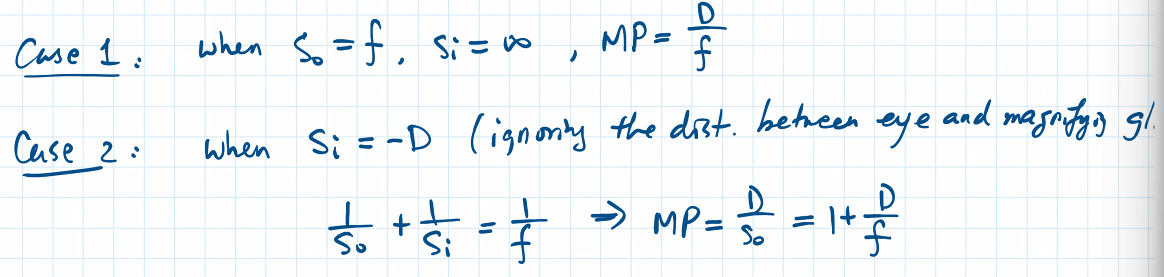 case 1: viewing object @ infty
case 2: viewing obj @ D
two extremes
image in between these two distances == case 1 < MP < case 2
case 1: viewing object @ infty
case 2: viewing obj @ D
two extremes
image in between these two distances == case 1 < MP < case 2