The polarisation of a wave describes its direction of oscillation. The polarisation vector describes the plane of vibration. There are two primary cases:
- A longitudinal wave has the displacement from equilibrium along the direction of propagation, i.e., .
- A transverse wave has the displacement perpendicular to the direction of propagation, i.e., . The image below shows transverse polarised waves.1
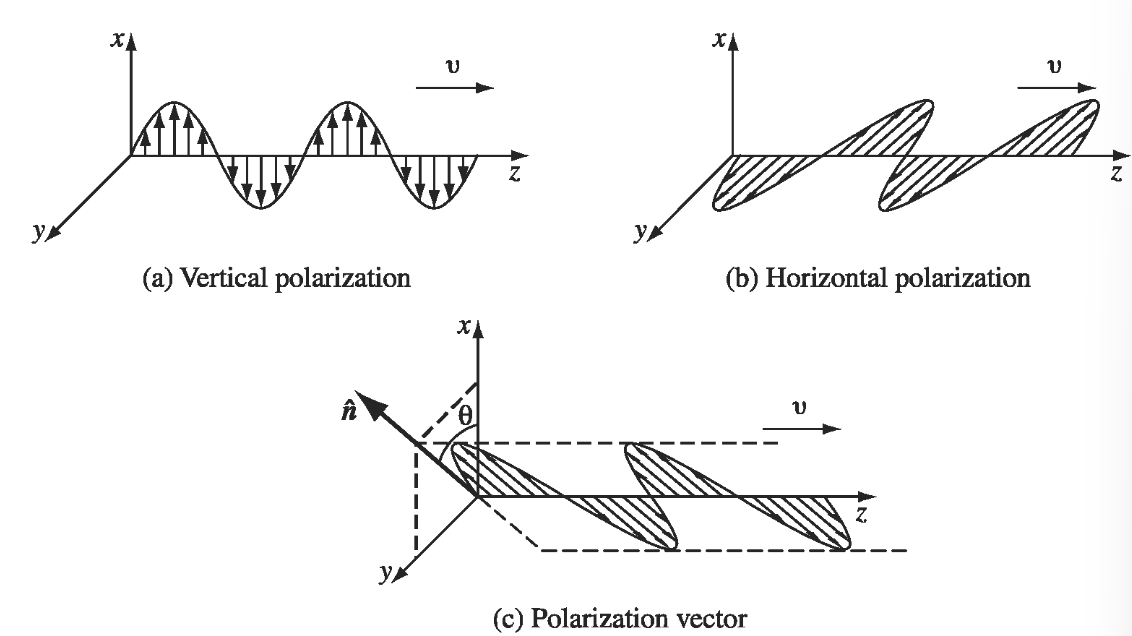
Basics
We describe polarisation in terms of a few core polarisation states, that describe the trajectory of the field vector over time at a fixed plane perpendicular to the direction of travel. For a wavefunction:
- Linear polarisation is when the time evolution of is a line on an -plane, assuming a propagation direction.
- This happens when , for an integer .
- Circular polarisation is when the time-evolution trace is a circle on the -plane.
- This happens when and .
- Elliptical polarisation happens in the remainder of cases.
- i.e., this happens in cases not covered above.
Both circular and elliptical polarisation are split into left/right-handed polarisation. We determine it primarily with the phase difference .
- If positive, it is left-hand polarised.
- If negative, it is right-hand polarised.
We usually also describe polarisation with Jones vector, which are 2D vectors that succinctly describe wave polarisation.
Devices
An optical device that polarises light is called a polariser. A basic type of polariser is the linear polariser, which filters out light waves that aren’t aligned with its transmission axis. The resulting light is linearly polarised in a single direction.
A few important parameters:
- The principal transmittance is the fraction of incident light parallel to the polariser’s transmission axis that is passed through.
- The minor transmittance is the fraction of incident linear light perpendicular to the transmission axis that is passed (or leaked) through by the polariser.
- The extinction ratio is the ratio of minor transmittance to principal transmittance.
See also
- Dielectric polarisation, which describes the alignment of molecular dipoles within a material in response to an applied electric field
Footnotes
-
From Introduction to Electrodynamics, by David J. Griffiths. ↩