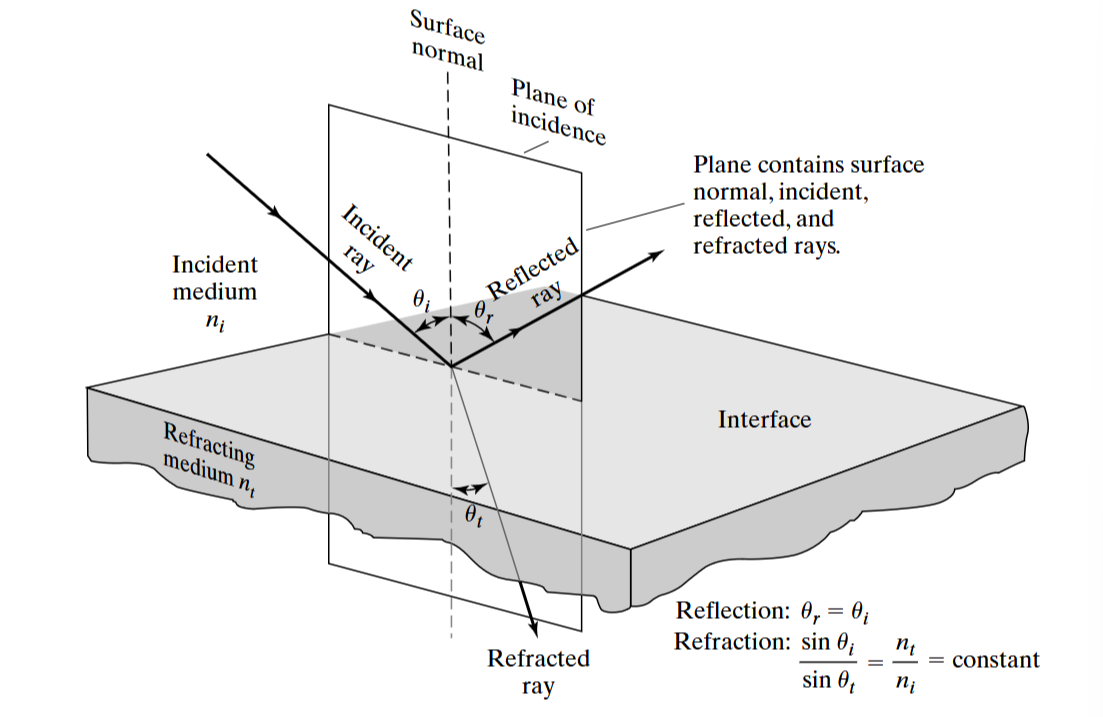
The law of reflection is one of the fundamental laws of geometric optics. It states that when a ray of light hits an interface dividing two optical media and reflects at the interface, the incident angle is equal to the reflective angle, .
We define as the incident angle (angle between ray and surface normal), as the reflected angle (angle between reflected ray and surface normal). For a curved surface, we can approximate with a small straight surface.
Derivation
We can derive the law of reflection with Fermat’s principle.
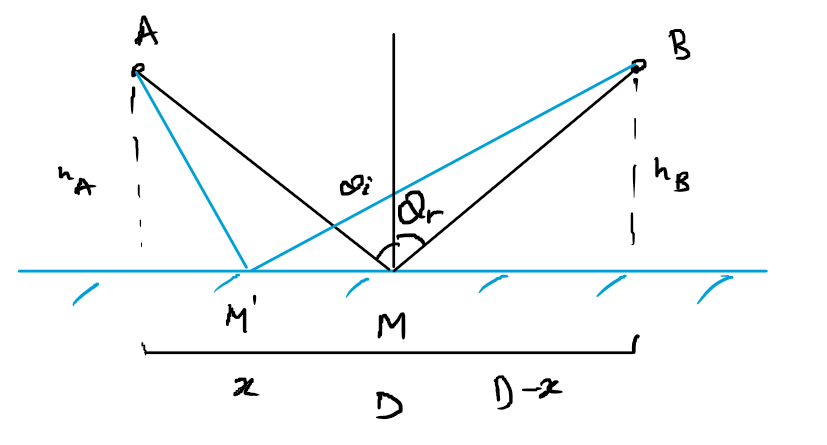 We want to prove that given , this OPL formulation is the shortest.
\frac{d\text{OPL}_{A\to B}}{dx}=0=n\left(\frac 12 \frac {2x}{\sqrt{h_A^2+x^2}}+\frac 12 \frac{2(D-x)}{\sqrt{h_B^2+(D-x)^2}}\right)
\frac{x}{\sqrt{h_A^2+x^2}}=\frac{D-x}{\sqrt{h_B^2+(D-x)^2}}
\frac{x}{\overline{AM}}=\frac{D-x}{\overline{BM}}
\sin\theta_i=\sin\theta_r
\theta_i=\theta_r