In computer networking, autonomous systems (also domains) are regions of aggregated groups of routers. They’re an important construct in the network layer.
Basics
Some basic ideas:
- Each autonomous system consists of multiple networks under a single administrative authority.
- “multiple networks” — physical networks like LANs, etc; IP subnets; and different routing domains within the organisation, like those that might belong to different departments (administration, student housing, etc.)
- “administrative authority” — in Canada, these would be big telcos like Rogers, Bell, or Telus.
- Each autonomous system should advertise its networks to other AS by sending information to one of the routers in the core AS. Routers must carry the AS number.
We define a few types of AS:
- A stub AS only has one connection to another AS. Data traffic can either be initiated or terminated in a stub AS (but not flow through!).
- A multihomed AS can have more than one connection to other autonomous systems. They should not route the traffic of the AS to which they are connected.
- i.e., they function like a stub AS in that they initiate or terminate data. They just have more links to outside AS that they can send data across.
- And a transient AS is connected to more than one AS and allows traffic to pass through.
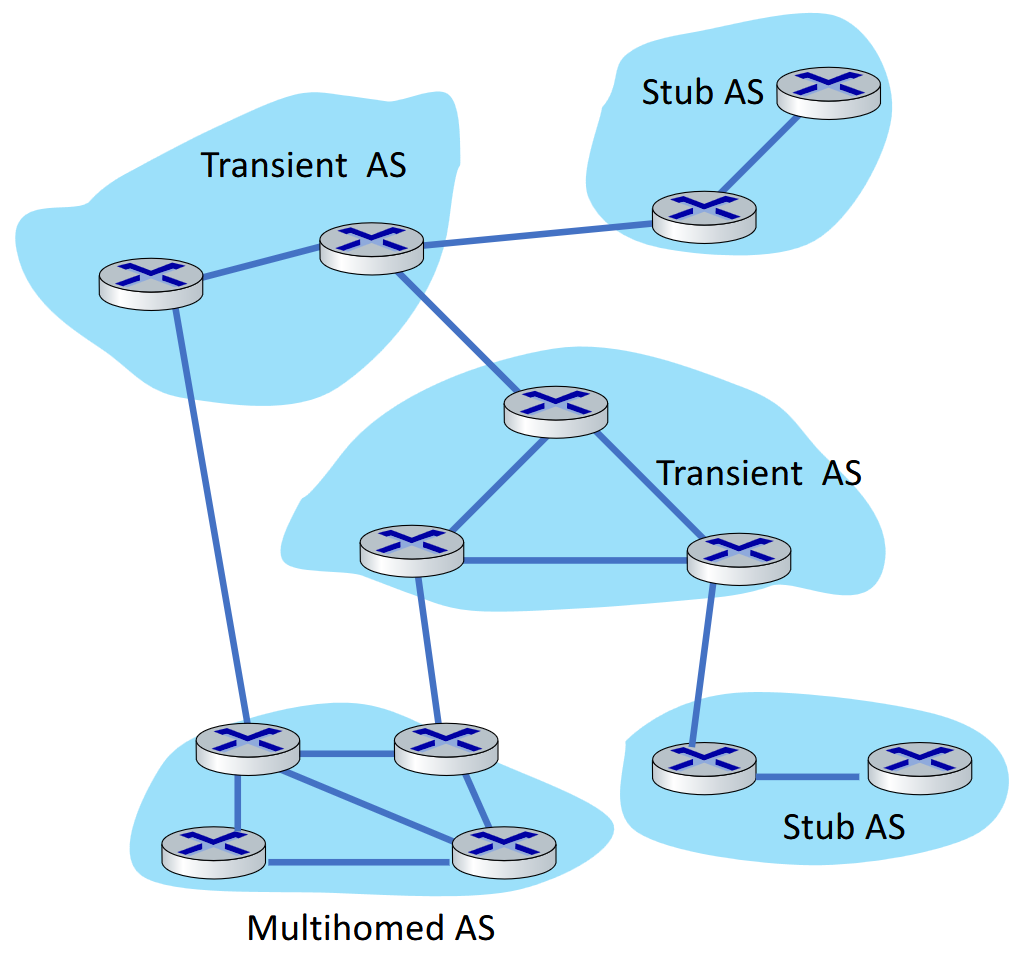
There are two types of routing.
- Routing intra-AS is between routers within the same AS. All routers in the AS must run the same intra-domain protocol. Routers in different AS can run different intra-domain routing protocols. At the “edge” of the AS, a gateway router has a link to routers in other AS.
- Routing inter-AS is among AS. Gateways perform inter-domain routing (as well as intra-domain routing).
- A datagram that is destined for an outside AS must be forwarded to a gateway router that might have a connection.
- Inter-domain routing must learn which destinations are reachable through directly adjacent AS, then propagate this reachability information to all routers in the self AS.
- The primary inter-AS routing protocol in use is BGP.
Within the gateway router, there’s a forwarding table that’s configured by both the intra- and inter-AS routing algorithms.