The eye is the primary biological optical organ. It’s useful as an analytical tool in geometric optics.
Construction
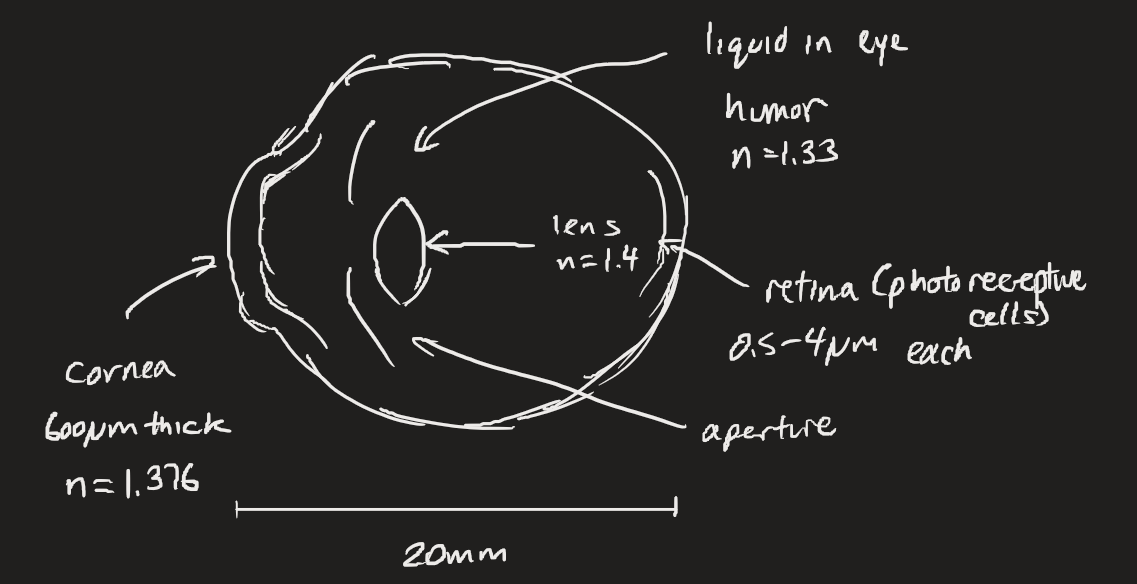
It’s made up of a few constituent components:
- The eye itself is around 20 mm wide.
- The cornea is at the surface of the eyeball. We approximate it as a spherical boundary between two interfaces.
- There’s a lens inside.
- The eyeball is made up of a liquid called the humor.
- There’s also an aperture, the opening of which is called the pupil.
- And the retina, which functions effectively as an imaging sensor. It contains photoreceptive cells (cones and rods).
 The eye is capable of a few key acts:
 - Adaption — control of the pupil size.
- Accommodation — adjustment of the lens’ focal length.
A few parameters associated with our vision:
- Object focal length — is around 12 mm. It varies as the eye accommodates, but not by too much.
- Near point — nearest position of distinct vision. For a healthy eye, we take it as .
- In other words, an object at the near point is at . This results in a specific image distance .
- If we add corrective lenses or contact lenses, this is fixed and we find a new .
- Far point — furthest position of distinct vision. For a normal eye, we take it as .
Conditions
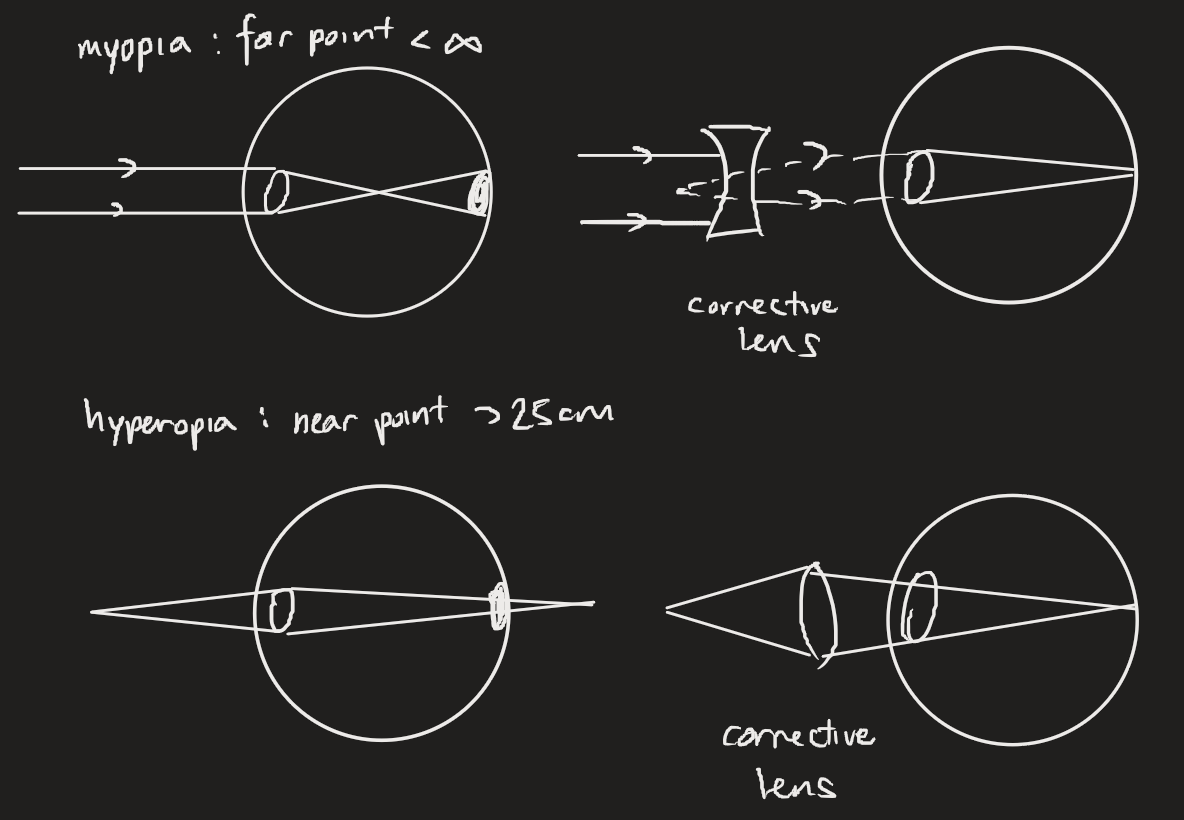 Common conditions associated with the eye:
- Myopia (near sightedness) — where the far point is less than . The result is that it creates a blur, since the rays don’t converge on the retina.
- We correct with a divergent lens (concave lens), such that the lens creates an upright virtual image (closer than the real object) that the eye treats as a real object.
- Hyperopia — where the near point is greater than 25 cm.
- We correct with a convergent lens (convex lens). The lens creates an upright larger virtual image further away from the eye than the real object.
- Astigmatism — where the cornea is asymmetric, i.e., . We correct with cylindrical lenses.
