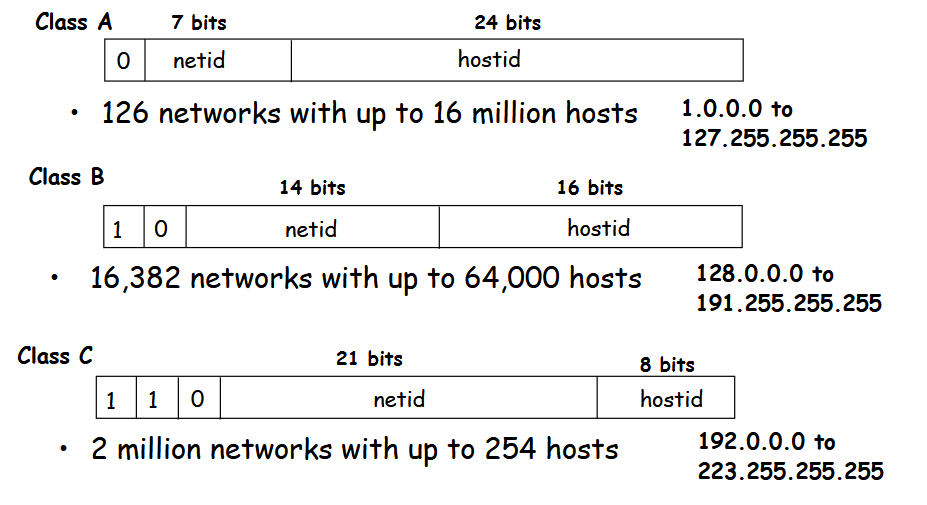
Classful addressing was an early and no longer used IPv4 addressing scheme. It divided IP addresses into 5 distinct classes:
- Class A allowed for 126 networks with up to 16 million hosts.
- Class B allowed for 16 382 networks with up to 64 000 hosts.
- Class C allowed for 2 million networks with up to 254 hosts.
- Class D was used for multicast communication (similar to broadcast, except it only delivers to a specific subset of nodes that have explicitly joined a particular group). This supported up to 250 million multicast groups at the same time, with permanent group addresses, temporary group addresses that were created as needed, and special multicast routers.
 There were also special reserved host IDs:
- All 0s would signify a host or host in this network.
- A broadcast address has
hostidset to all 1s.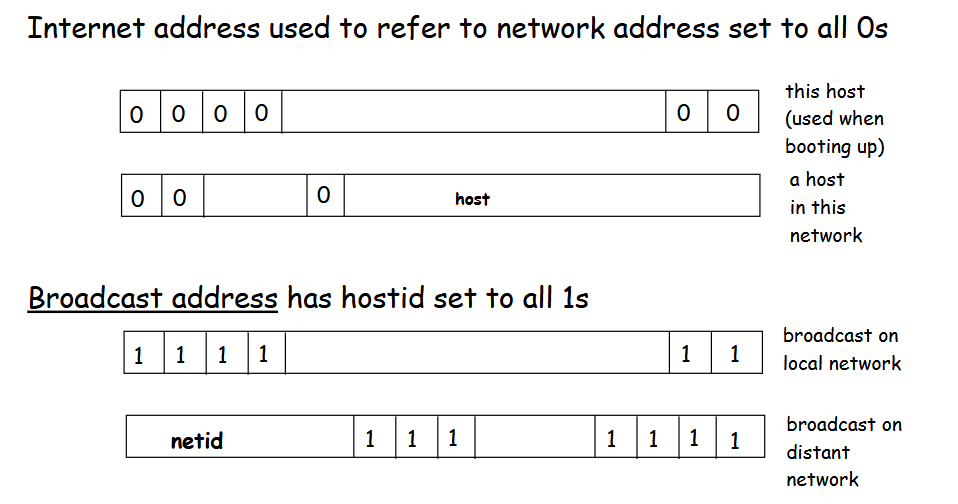
There were several problems with classful addressing:
- Inefficient allocation — a small organisation needing 300 addresses would get a class B with 65 534 addresses, wasting most of them. This also accelerated the depletion of IPv4 addresses.
- Routing table explosion — as the Internet grew, routing tables became unmanageably large (wrt number of entries).