A proxy server (or web cache) is used in computer networking to satisfy client requests without involving origin servers. The browser will point to a web cache, and all HTTP requests will be sent to the cache.
They’re typically located physically closer to users, and installed by the ISP (university, company, residential ISP). As with other caching mechanisms, the cache acts both as a client and a server.
Web caching is useful because it can reduce response time for a client request or reduce traffic on an institution’s access link. The Internet is dense with caches, because they allow poor content providers to more effectively deliver content.
Timing
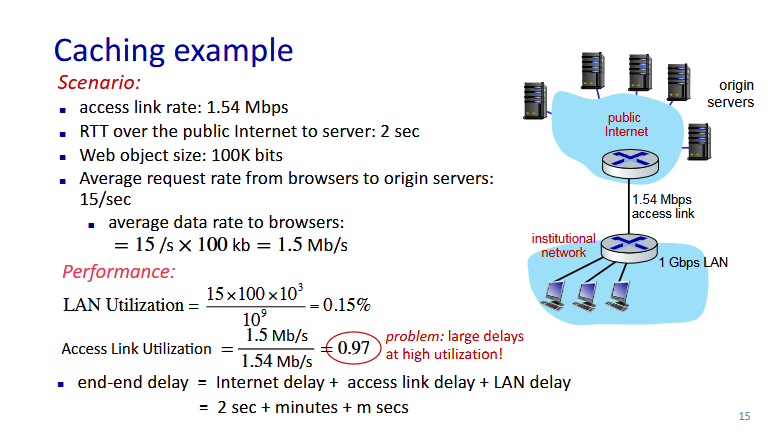
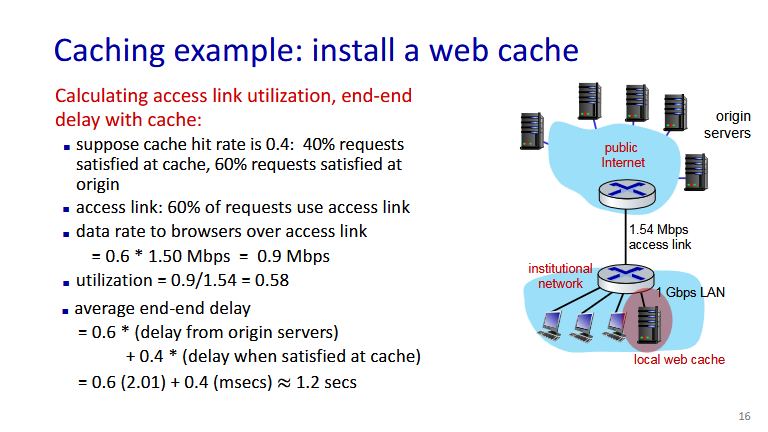
Suppose instead of using a cache, we increase the rate of the outgoing link to 154 Mb/s
Access Link Utilisation = 1.5 Mb/s 154 Mb/s ≈ 0.01 end-to-end delay = internet delay + access link delay +LAN delay = 2 sec + m sec ≈ 2 sec Caching has a smaller end-end delay than