In computer networking, the packet delay is the amount of time between the transmission of the first bit of a data packet from device and receiving the final bit from device .
Basics
For a simple single link between two devices, the transmission delay is defined by the number of bits and the transmission rate in bits/second. Additionally, there’s propagation delay associated with the physical medium the data travels. For example, if fibre optic cables, then it’s defined by the distance divided by the speed of light.
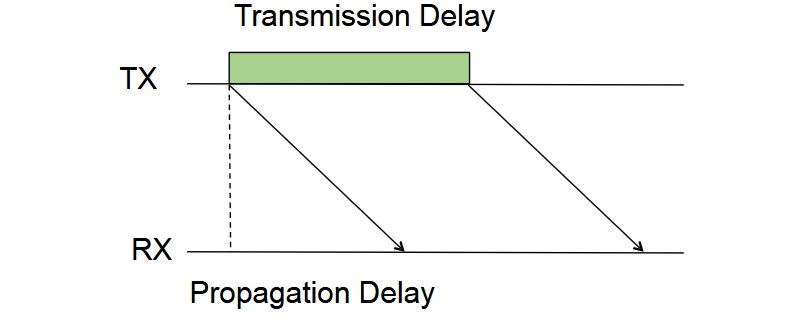 Packet switching slightly complicates this. In larger networks, packets are forwarded from one router to the next to get from source to destination. There are a few mechanisms:
- Store-and-forward — where the entire packet must arrive at the router before it can be transmitted on the next link.
- Cut-through — where the information about the destination is at the header of the packet. After the header has arrived, the route has been found and the rest of the packet is transmitted without being stored.
Note that the amount of time is defined primarily by the number of links, not the number of nodes in the route. For a two-link route:
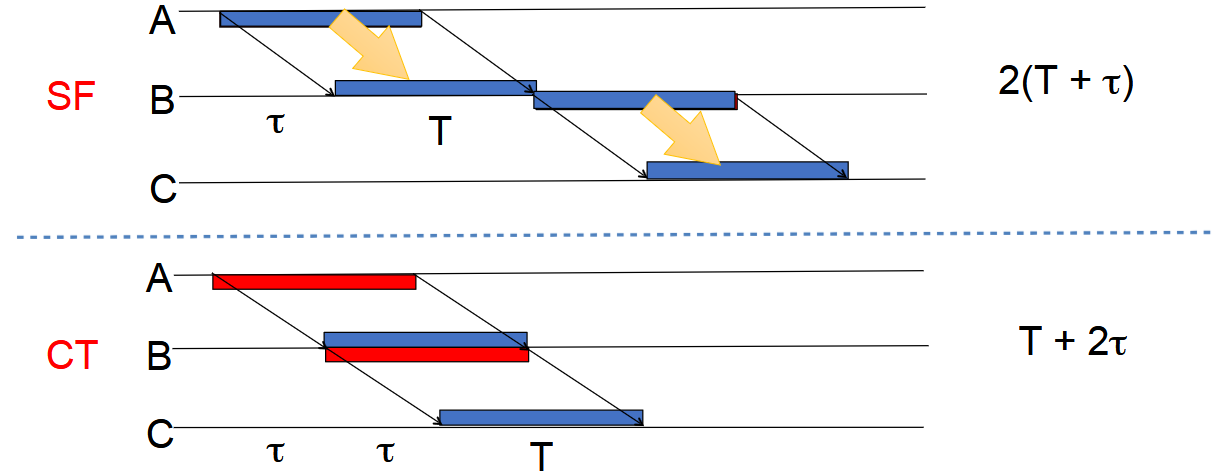
Full picture
In practice, with multiple connections, routers often have to queue up the packets in a buffer, while the router transmits from the buffer. If the arrival rate to the link exceeds the output link capacity, we get packet loss, where the packet is rejected from the queue. It may be resent by the previous node, or not at all.
In general, a node has four sources of delay:
where:
- (nodal processing) — checks for bit errors (think parity bits), determines output link. This is typically less than 1 ms.
- (queueing delay) — time a packet waits at an output link for transmission. This depends on the congestion level of the router.
The packet queueing delay is defined by the traffic intensity. At 0, the average queueing delay is small. As it approaches 1, the average queueing delay is large. At more than 1, the work arriving is more than can be serviced (likely packet loss). The intensity and average intensity are given by:
ECE361 — Computer Networks I how can we decrease each component?
- tx delay → faster output link
- processing delay → faster hw/cpu
- prop delay → cannot
- queueing delay → better network management/congestion control