Circuit switching is a mechanism to move data through a network of links and switches. In circuit-switched networks, the resources needed along a path (like buffers or link transmission rate) needed for communicating between end systems are exclusively reserved for the duration of their communication, even if the channel is idle. This means circuit switching is generally less efficient.
When one node wants to begin sending information, it has to establish a connection (i.e., get allocated links), which has some overhead. After it has established a connection, it gets a constant transmission rate (i.e., a fraction of the network’s capacity), which has a reliably slow delay.
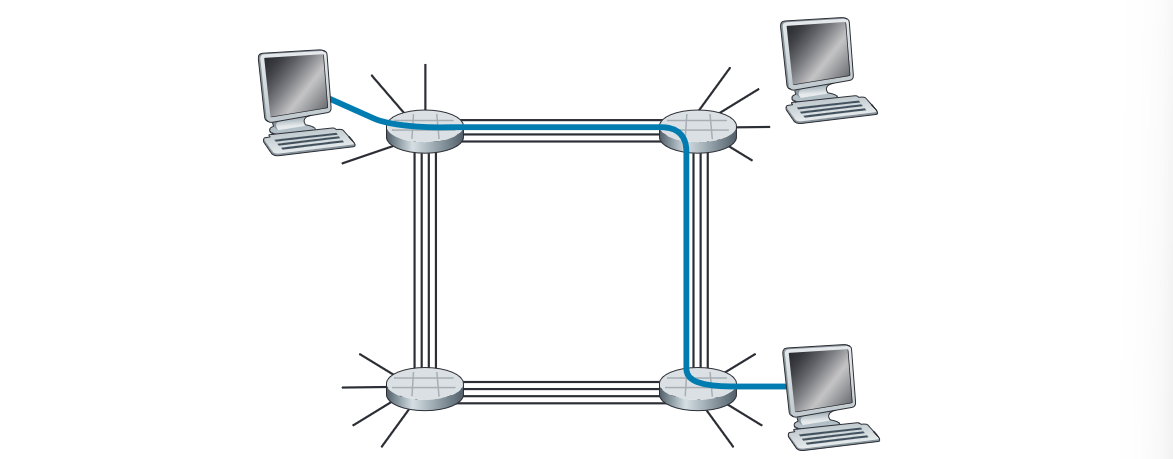
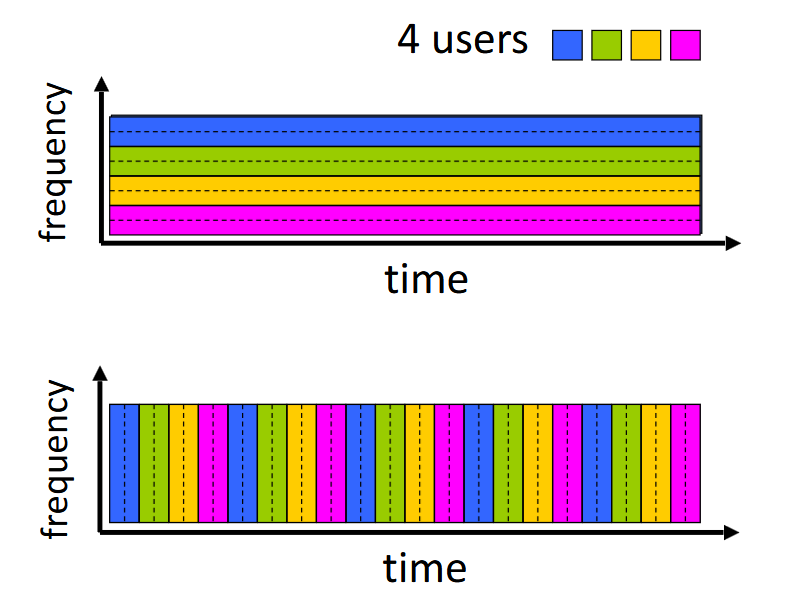
The network’s capacity is mainly split by a process called multiplexing. The result of both methods is that circuit switching generally supports less users.
- In frequency-division multiplexing (FDMA), a signal with a combination of multiple frequencies is sent across the links. One frequency is reserved for the communication and extracted at the receiver. Unused frequencies are idle.
- In time-division multiplexing (TDMA), time is divided into periodic, fixed slots. Each call is allocated one slot that it can access in rounds. Unused slots go idle.
See also
- Packet switching, which is mainly used for Internetworking